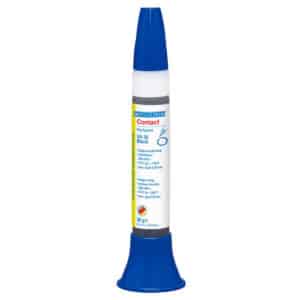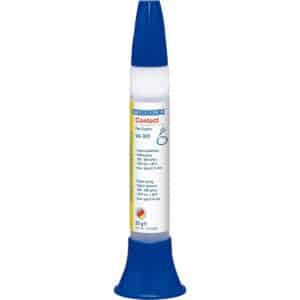
Weicon Contact VA 1408 Cyanoacrylate Adhesive


 Shipping Time 24 Hours : Weekdays 09:00-17:00
- 100% Original: All products with UTM Teknik guarantee


Weicon Contact VA 1408 Cyanoacrylate Adhesive is a low-viscosity, very fast-curing industrial adhesive developed for applications with special requirements. It is formulated to be less sensitive to moisture after curing and stands out where clean, mark-free bonding is needed. Because it is designed with low odor and reduced whitening (blooming), it is preferred for aesthetically critical assemblies. The manufacturer is WEICON GmbH & Co. KG, and the product is of German origin.
Chemical basis and core performance profile of VA 1408
This product is a single-component industrial adhesive based on alkoxy cyanoacrylate chemistry and is applied in liquid form. Its low-viscosity range is specified as 20–40 mPa·s, allowing it to penetrate narrow gaps easily and enabling controlled application on small parts. Since the maximum gap-bridging capacity is stated as 0.1 mm, the best results are typically achieved on well-fitting surfaces and with a thin bond line. Curing begins with initial fixation “within seconds”; a 24-hour period is given for full strength development.
Application method and surface compatibility as an industrial adhesive
Before application, surfaces should be clean and dry, as dust, dirt, and moisture can negatively affect bonding. This industrial adhesive performs efficiently when applied to only one surface and the parts are joined quickly, making it suitable for serial assembly rhythms. While mechanical roughening is recommended on very smooth surfaces, for difficult-to-bond plastics (such as PE, PP, POM, PTFE), TPEs, and silicones, surface preparation with a suitable CA primer is advised. The product can be preferred for different material combinations where a clean and visually neat bond line is targeted.
Curing conditions and temperature resistance
Because curing starts with ambient moisture, bonding time and results are influenced by environmental conditions. The recommended application temperature range is +15 °C to +40 °C, and a relative humidity range of 40–70% is specified. It is noted that curing can slow down significantly at very low humidity, and that very high humidity or certain surface conditions may pose a risk of sudden curing. Temperature resistance is stated as -50 °C to +80 °C, with short-term exposure up to +100 °C, so process conditions should be planned accordingly for heat-exposed assemblies.
Dosing control and practical tips to reduce errors
A layer thickness of 0.05–0.2 mm is recommended; thicker applications can make full curing more difficult. For large surfaces, spot application can help reduce internal stresses and create a more balanced bond line. In terms of consumption, it is stated that a single drop can be sufficient for approximately 3–5 cm² of bonding area, helping cost control in production. If curing is delayed on porous, passive, or unsuitable conditions, the process can be supported by using an activator.
Strength approach, typical bond performance, and standard information
The technical documentation shares shear strength ranges for different materials according to DIN EN 1465; for example, 14–18 MPa on grit-blasted steel and 8–12 MPa on grit-blasted aluminum are given. Strength values are also listed for plastics such as unprocessed rigid PVC, ABS, and polycarbonate in ranges that vary by material, supporting the practical importance of correct surface preparation. In addition, product references identified by ISSA and IMPA codes are provided; these kinds of codes can be used as references especially in marine and industrial supply classifications. Within the fast-curing industrial adhesive class, it fits processes aiming for “cleaner” assembly thanks to its low odor and reduced whitening behavior.
Additional information
| Miktar | 30 g, 500 g, 60 g |
|---|