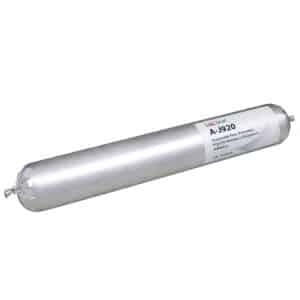
L&L Seal A-J920 Solvent-Free Elastomeric Adhesive


 Shipping Time 24 Hours : Weekdays 09:00-17:00
- 100% Original: All products with UTM Teknik guarantee


Item(s) left: 0


L&L Seal A-J920 is defined in official manufacturer documents as a one-component, primerless, low-sag, high-performance elastomeric industrial adhesive. The product was developed to create a strong yet flexible bond in applications that aim to combine bonding and sealing within the same process line. It offers process simplification potential especially in assemblies where glass, metal, and composite surfaces are used together. The product is part of the L&L Seal series developed by L&L Products, headquartered in Romeo, Michigan, USA. In Turkey, it is supplied through the company’s official distributor, UTM Teknik.
Technical structure and performance characteristics of A-J920
This product has a one-component, elastomeric formulation that is free of solvents, isocyanates, and VOCs, and it is applied at room temperature and cures with ambient moisture. According to the official product sheet, it provides a tensile strength of at least 5.5 MPa, an elongation at break of at least 300%, and a lap shear strength of 3.5 MPa on an aluminum reference surface at 23°C. The cure rate is given as approximately 3–4 mm per 24 hours, which allows controlled progression in assemblies requiring thick bond lines. Its low-sag behavior, high initial grab, and ability to form a void-free elastomeric bond make this industrial adhesive stand out in applications where both bonding and sealing functions are expected together. The manufacturer also identifies lifecycle durability and low shrinkage as key performance features of the product.
Surface compatibility and application method
A-J920 is positioned for use on a broad range of surfaces including composites, metals, glass, and ceramic glass. According to official information, its ability to eliminate the need for primer or pretreatment on many surfaces reduces preparation steps on the assembly line. Its easy dispensing without mixing and its suitability for direct-to-glass bonding provide an important application advantage, especially for manufacturers operating continuous production lines. Its ability to be painted even before full cure is completed, with a low tendency for paint cracking, adds flexibility in finishing operations. These technical properties support the product’s use as an industrial adhesive suitable for different scales, from field application to serial production.
Process advantages and compliance information
The product’s high viscosity and thixotropic structure help maintain the shape of the part by providing high green strength before curing. Its ability to cure without heat or UV activation reduces equipment dependency while simplifying process design. For lines requiring shorter cycle times, it is stated that handling strength can be achieved in approximately 1 hour with A-J280 accelerator paste, or in the 30–35 minute range at lower ratios. The official product sheet also includes ISEGA approval for food-contact applications and EN45545-2 compliance for rail systems.
Sectoral areas of use for A-J920
Among the areas where this product stands out, transportation applications are at the forefront. The installation of large and heavy glass panels, cassette-type glass bonding, caravan and RV systems, and glass installation in construction and agricultural vehicles are among the use cases explicitly identified by the manufacturer. It may also be preferred in joints requiring gasket sealing because of its ability to provide both bonding and sealing in the same application. In rail systems, EN45545-2 compliance makes the product more meaningful for related interior and exterior assembly applications. In construction applications, it is positioned as a system solution for glass bonding and as an alternative industrial adhesive approach to traditional PU technologies.
Key advantages and assembly efficiency
The main advantage of A-J920 is that it combines high strength and elastic behavior in the same structure. Its primerless nature, no-mix application, low sag, and paintability provide practical gains by reducing maintenance, preparation, and application times. Thanks to its compatibility with different surfaces such as composite, metal, and glass, a wider range of assembly scenarios can be managed with a single product. For this reason, the product is a balanced industrial adhesive solution not only for companies seeking strong bonding, but also for those looking for process efficiency, safer use, and a simpler application flow.
L&L Seal A-J920 is defined in official manufacturer documents as a one-component, primerless, low-sag, high-performance elastomeric industrial adhesive. The product was developed to create a strong yet flexible bond in applications that aim to combine bonding and sealing within the same process line. It offers process simplification potential especially in assemblies where glass, metal, and composite surfaces are used together. The product is part of the L&L Seal series developed by L&L Products, headquartered in Romeo, Michigan, USA.
Technical structure and performance characteristics of A-J920
This product has a one-component, elastomeric formulation that is free of solvents, isocyanates, and VOCs, and it is applied at room temperature and cures with ambient moisture. According to the official product sheet, it provides a tensile strength of at least 5.5 MPa, an elongation at break of at least 300%, and a lap shear strength of 3.5 MPa on an aluminum reference surface at 23°C. The cure rate is given as approximately 3–4 mm per 24 hours, which allows controlled progression in assemblies requiring thick bond lines. Its low-sag behavior, high initial grab, and ability to form a void-free elastomeric bond make this industrial adhesive stand out in applications where both bonding and sealing functions are expected together. The manufacturer also identifies lifecycle durability and low shrinkage as key performance features of the product.
Surface compatibility and application method
A-J920 is positioned for use on a broad range of surfaces including composites, metals, glass, and ceramic glass. According to official information, its ability to eliminate the need for primer or pretreatment on many surfaces reduces preparation steps on the assembly line. Its easy dispensing without mixing and its suitability for direct-to-glass bonding provide an important application advantage, especially for manufacturers operating continuous production lines. Its ability to be painted even before full cure is completed, with a low tendency for paint cracking, adds flexibility in finishing operations. These technical properties support the product’s use as an industrial adhesive suitable for different scales, from field application to serial production.
Process advantages and compliance information
The product’s high viscosity and thixotropic structure help maintain the shape of the part by providing high green strength before curing. Its ability to cure without heat or UV activation reduces equipment dependency while simplifying process design. For lines requiring shorter cycle times, it is stated that handling strength can be achieved in approximately 1 hour with A-J280 accelerator paste, or in the 30–35 minute range at lower ratios. The official product sheet also includes ISEGA approval for food-contact applications and EN45545-2 compliance for rail systems.
Sectoral areas of use for A-J920
Among the areas where this product stands out, transportation applications are at the forefront. The installation of large and heavy glass panels, cassette-type glass bonding, caravan and RV systems, and glass installation in construction and agricultural vehicles are among the use cases explicitly identified by the manufacturer. It may also be preferred in joints requiring gasket sealing because of its ability to provide both bonding and sealing in the same application. In rail systems, EN45545-2 compliance makes the product more meaningful for related interior and exterior assembly applications. In construction applications, it is positioned as a system solution for glass bonding and as an alternative industrial adhesive approach to traditional PU technologies.
Key advantages and assembly efficiency
The main advantage of A-J920 is that it combines high strength and elastic behavior in the same structure. Its primerless nature, no-mix application, low sag, and paintability provide practical gains by reducing maintenance, preparation, and application times. Thanks to its compatibility with different surfaces such as composite, metal, and glass, a wider range of assembly scenarios can be managed with a single product. For this reason, the product is a balanced industrial adhesive solution not only for companies seeking strong bonding, but also for those looking for process efficiency, safer use, and a simpler application flow.