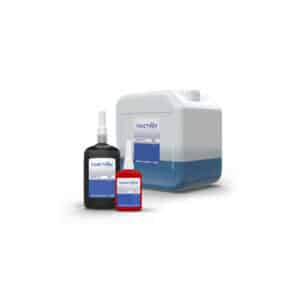
Weicon WEICONLOCK AN 301-70 Anaerobic Threadlocker Sealant


 Shipping Time 24 Hours : Weekdays 09:00-17:00
- 100% Original: All products with UTM Teknik guarantee


Weicon WEICONLOCK AN 301-70 is a high-strength, anaerobically curing industrial adhesive that helps prevent loosening in metal threaded connections. Its green formulation supports application control during assembly and is positioned as a marking-free threadlocker for fasteners. It hardens in the oxygen-free zone where metal surfaces are in contact, filling the thread gaps and helping reduce the risk of loosening under vibration. It is preferred for high-strength assemblies where disassembly during service is expected to be difficult.
Secure locking in threaded joints with WEICONLOCK AN 301-70
This product is a medium-viscosity industrial adhesive intended to create a mechanical locking effect on bolts, nuts, and studs. By penetrating the thread gaps, it limits movement within the joint and provides a more stable assembly against vibration-induced loosening. Since it also fills the thread clearances, it can additionally provide a sealing effect that helps reduce leakage paths in suitable designs. As it is described as NSF-tested and marking-free, it stands out in processes where clean assembly is required. The manufacturer is WEICON GmbH & Co. KG, and the product is of German origin.
Technical properties and strength approach
This industrial adhesive in the WEICONLOCK range is specified for use on threaded connections up to size M25, with a maximum gap-filling capacity of 0.15 mm. Because its viscosity at +25 °C (Brookfield) is given as 500–900 mPa·s, it offers a consistency suitable for controlled application with low run-off. For threaded connections, the breakaway torque is defined as 25–35 Nm and the prevailing torque as 40–50 Nm; these values match a high-strength locking target. Shear strength is specified as 14–20 N/mm² according to DIN 54452, supporting a strong bond-line approach when proper surface preparation is applied. With a temperature resistance stated as -60 °C to +150 °C, it provides a thermal window suitable for many industrial assembly environments.
Curing behavior and process planning
Because the anaerobic system cures in a metal-contact, oxygen-free zone, assembly timing directly affects performance. Reaching handling strength within 5–15 minutes at room temperature helps keep waiting times manageable in production and maintenance operations. Since the time to full strength is given as 5–10 hours, full loading or functional testing should be planned with this period in mind. For healthy curing progression, tightening to the appropriate torque and avoiding movement of the joint are important. This approach makes it easier to achieve repeatable results when using a high-strength industrial adhesive.
Application steps and surface preparation
Keeping surfaces clean, dry, and free of oil is a critical step for uniform curing within the thread gaps. The product should be applied circumferentially directly onto the thread using the nozzle, and the fasteners should be assembled and tightened to the desired position without delay. Although lightly oily surfaces are stated to be tolerable, working on cleaned parts is a safer process for best results. The product must not be poured back into the bottle after contacting metal, as even tiny metal particles can trigger premature curing inside the packaging. In serial applications, controlled dispensing with manual or automatic dosing tips can help reduce consumption and application errors.
Sector-based applications and compatible surfaces
This industrial adhesive can be used in machinery manufacturing, automotive supply, maintenance and repair (MRO), pump/compressor assemblies, and general fastener locking requirements. It is preferred at joints requiring high strength, especially to reduce the risk of bolt-and-nut loosening in vibrating equipment. In hydraulic and pneumatic systems where fasteners need to remain stable, it provides a supportive chemical solution that contributes to assembly safety. It is primarily used with typical metal fasteners such as steel, and with proper surface preparation it can be process-compatible across different metal combinations. Due to its high-strength class, selection should consider scenarios where disassembly during service may become difficult.
Additional information
| Miktar | 200 ml, 50 ml |
|---|
Related products