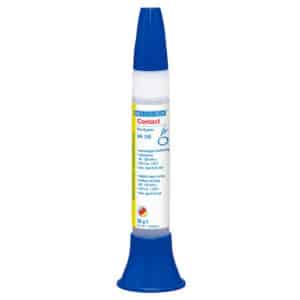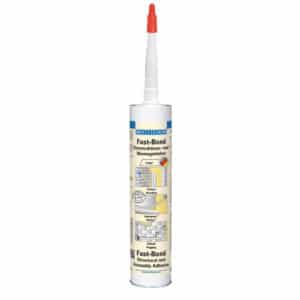
WEICON Contact Gel Cyanoacrylate Adhesive 20 g


It is a gel-consistency, cyanoacrylate-based industrial adhesive that reduces run-off and enables controlled application. It is suitable for the rapid assembly of metal and plastic parts and for maintenance/repair fixings, especially on porous substrates and in higher-tolerance joints.
 Shipping Time 24 Hours : Weekdays 09:00-17:00
- 100% Original: All products with UTM Teknik guarantee


Gel-type cyanoacrylate systems are commonly used when fast bonding must be combined with precise, clean application in assembly and maintenance. WEICON Contact GEL (20 g) is positioned as an industrial adhesive with a thixotropic, paste-like consistency that helps limit run-off, especially on vertical surfaces. The manufacturer describes it as suitable for porous substrates and for joints with higher tolerances where controlled placement is required. The product is manufactured by WEICON GmbH & Co. KG in Germany.
Contact GEL industrial adhesive: gel consistency for controlled bonding
This industrial adhesive is based on ethyl cyanoacrylate chemistry and is formulated in a gel form to support more controlled application than low-viscosity instant adhesives. The paste-like behavior is intended to keep the adhesive at the application point, which can be beneficial for vertical bonding and localized bonding tasks. The product is described for use on porous surfaces and in assemblies where parts may not mate perfectly, provided the joint design stays within the manufacturer’s limits. Because cyanoacrylates cure via moisture-triggered polymerization, the process outcome depends strongly on surface condition and ambient environment.
Curing behavior, environmental effects, and process control options
Moisture and surface chemistry influence both the initial set and the time to reach full strength, so stable shop conditions help ensure repeatable results. The manufacturer notes that an activator can be used to reduce curing time, which can support shorter cycle times or compensate for slow curing in less favorable conditions. If humidity is too low, curing may slow significantly, while very high humidity and certain surface chemistries can cause overly rapid curing and may negatively affect bond quality. For production planning, it is important to distinguish between early handling strength and final strength development, and to avoid loading the joint prematurely. These points make process validation on the actual substrates a practical requirement for consistent outcomes with any industrial adhesive in this class.
Gap bridging limits and realistic joint design expectations
Although the gel form supports better control, it should not be treated as a true gap-filling compound for large clearances. The manufacturer states that the maximum gap bridging capacity is limited, and excessive adhesive layer thickness can prevent reliable full curing. Joint geometry, surface contact quality, and part rigidity are therefore decisive for performance. For tolerance-heavy assemblies, reducing the bondline thickness and improving surface fit typically improves consistency and durability. Where the joint design cannot be optimized, using an activator and carefully controlling the application amount can help stabilize the process.
Application method, surface preparation, and compatible substrates
Successful bonding depends on clean, dry surfaces, because oils, dust, and moisture can reduce adhesion and cause variability in cure behavior. The manufacturer recommends preparing smooth surfaces by roughening where appropriate and ensuring thorough degreasing before application. The adhesive is typically applied to one surface, parts are joined promptly, and alignment is maintained until handling strength is achieved. For larger bonding areas, spot application can help reduce internal stresses and improve overall joint reliability. On difficult-to-bond plastics such as polyolefins, the manufacturer recommends using a primer as a surface pre-treatment to improve bonding performance.
Industrial use cases by sector and practical advantages
In automotive and industrial manufacturing, the gel consistency can be useful for fast fixing of small components, clips, trims, and accessory parts where clean placement matters. In general assembly, it can support quick bonding steps where fixturing is limited and controlled application on vertical surfaces is required. In maintenance and repair operations, it is relevant for on-site bonding of small parts, temporary positioning, and quick stabilization tasks, especially when porous substrates are involved. The key practical advantages are controlled, non-sag application and a curing profile that can allow brief repositioning, while an activator option can help manage cycle time when needed. When selecting this industrial adhesive, performance should be confirmed through trials on the actual substrates and joint geometry used in the process.