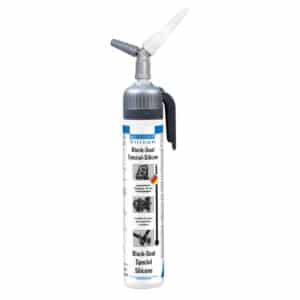
Weicon WEICONLOCK® AN 305-67 Anaerobic Thread and Flange Sealant


It is an anaerobic, PTFE-filled industrial adhesive used for sealing pipe threads and flange surfaces. It helps reduce leak risk in process lines, compressed air, and installation connections. Its low-strength profile offers the advantage of easy removability during service.
 Shipping Time 24 Hours : Weekdays 09:00-17:00
- 100% Original: All products with UTM Teknik guarantee


Weicon WEICONLOCK® AN 305-67 Anaerobic Thread and Flange Sealant is an anaerobic industrial adhesive designed to provide sealing on pipe threads and flange surfaces. Its PTFE-filled formulation focuses on reducing leak risk by filling connection gaps and offers a practical sealing solution for maintenance processes. Because it is positioned in a low-strength class, it can be preferred for connections where easy disassembly during service is desired. The product is manufactured in Germany by WEICON GmbH & Co. KG.
Pipe thread and flange sealing with AN 305-67
This industrial adhesive is used for sealing on pipe threads and flange surfaces, and its high-viscosity character helps reduce the tendency to run during application. A usage range is specified up to M80 for threaded connections and up to R 3″ for pipe threads, indicating it can also be considered for large-diameter installations and line connections. The product is white and has no fluorescent property. A maximum gap-bridging capacity of 0.6 mm supports a sealing approach even in higher-tolerance joints. Its low-strength profile is an advantage for applications that prioritize serviceable sealing rather than locking the connection.
Technical performance and strength range
The viscosity range is given as 170,000–410,000 mPa·s, showing the product is a very thick industrial adhesive/sealing agent that can remain stable on threads. Breakaway torque is stated as 3–5 Nm and prevailing torque as 2–4 Nm, which technically supports the expectation of easier disassembly. Shear strength according to DIN 54452 is specified as 6–8 N/mm², aiming for sufficient surface adhesion alongside sealing. Handling strength is given as 120–240 minutes, and final strength is reached within 24–72 hours; therefore, commissioning should be planned according to the curing window. Temperature resistance is defined as -50 °C to +175 °C, and the minimum shelf life at room temperature is stated as 24 months.
Anaerobic curing and the role of PTFE filler
This product is a single-component anaerobic system that cures where oxygen is excluded between metal surfaces; therefore, its typical application is metal threaded connections and flange joints. The PTFE filler supports the formation of a sealing film and the filling of micro-gaps. Its low-strength class indicates proper positioning for lines where “full locking” is not expected under vibration but sealing is critical. Surface cleanliness significantly affects the consistency of the result; cleaner surfaces generally mean more predictable performance. In this context, the product stands out for applications aiming to balance service ease and sealing performance.
Application steps and surface preparation
For optimum results, it is recommended that the fittings are degreased and clean; if necessary, light roughening can be used to increase adhesion. Application is carried out evenly on the thread in circular movements using the dosing nozzle on the package, then the pipe thread is tightened and aligned to the desired position. For flange sealing, it is applied as a continuous bead to one side of the flange, after which the parts are quickly assembled and tightened. It is important not to let the dosing nozzle directly touch metal and not to pour product that has contacted metal back into the container; even very small metal particles can cause unwanted curing inside the packaging. Storing it at room temperature in the closed original container away from heat sources and direct sunlight supports process reliability.
Industry applications and key advantages
This industrial adhesive can be used for pipe thread sealing needs in process lines, water/wastewater installations, compressed air systems, compressor connections, and general industrial maintenance applications. In machine manufacturing and maintenance, it offers practicality at flange joints where using an additional gasket becomes difficult or where quick intervention is needed. High viscosity makes control easier in vertical or hard-to-reach areas, while the low-strength class supports the expectation of removability. The broad thread range specification and gap-bridging capacity up to 0.6 mm provide flexibility across different tolerance scenarios. Having a defined, plannable curing time range helps maintenance schedules and commissioning proceed more predictably.
Additional information
| Miktar | 200 ml, 50 ml |
|---|