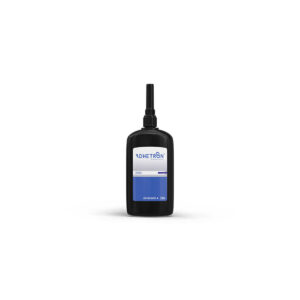
WEICON WEICONLOCK AN 302-71 Anaerobic Thread Sealant


 Shipping Time 24 Hours : Weekdays 09:00-17:00
- 100% Original: All products with UTM Teknik guarantee


WEICON WEICONLOCK AN 302-71 Anaerobic Thread Sealant is an anaerobic industrial adhesive solution developed to reduce loosening in threaded connections and stud bolts. Its medium-viscosity structure supports controlled application without running on the threads and strengthens the locking effect by filling gaps inside the joint. Because it cures in a high-strength class, it is preferred especially for assemblies where removal is not desired or where a long service life is targeted. Its red color makes it easier to visually control the application line, contributing to standardization in production and maintenance processes.
Thread-locking approach and working principle of AN 302-71
AN 302-71 works as an anaerobic, resin-based industrial adhesive that cures in narrow gaps between metal surfaces when contact with air is cut off. By filling the thread gaps, it limits micro-movements and helps reduce vibration-related loosening. The same mechanism supports joint integrity by helping block capillary leak paths along the thread line. The product is specified for use on threaded connections up to M20 (R 3/4”) and supports tolerance management with a maximum gap-bridging capability of 0.15 mm.
Performance profile, strength, and service conditions
With a medium viscosity (approx. 5,000 mPa·s), the product aims for balanced spreading on threads and improves assembly repeatability. Breakaway torque is given as 28–35 Nm and prevailing torque as 50–65 Nm, supporting high-strength locking behavior. Shear strength is reported as 15–20 N/mm², so joints should be planned as “difficult to remove.” Temperature resistance is stated as -60 °C to +150 °C, which fits typical operating conditions in many machine and installation applications. In terms of storage, it has a stated stability of at least 24 months at room temperature in its unopened original packaging.
Curing process and process planning
AN 302-71 typically reaches initial handling strength within 10–20 minutes, and full strength development is given as 3–6 hours. Therefore, post-assembly loading should be planned in a controlled way, especially during the first hours. It should be considered that curing speed may differ on more “passive” metals such as stainless steel; if the process is critical, process control can be evaluated with auxiliary products such as accelerators/activators. Avoiding movement of the joint before curing is complete helps the locking line form uniformly.
Application method and surface preparation
For best results, surfaces should be cleaned of oil, dirt, and loose oxides; a clean metal surface directly determines performance for this type of industrial adhesive. The product should be applied evenly using the dispensing tip, and care should be taken not to let the tip contact metal directly. For sealing purposes, the material is applied to the thread in circular movements, the parts are assembled, and the target tightening is achieved. Not returning product that has contacted metal back into the bottle is a critical practice to reduce the risk of premature curing inside the container.
Industry applications and compatible systems
In machine manufacturing, it can be used to reduce loosening under vibration in auxiliary threaded connections of equipment such as gearboxes, pumps, and compressors. In maintenance and repair operations, it offers a permanent locking approach for stud bolt connections, auxiliary threads on flanged equipment, and assemblies with a risk of self-loosening during service. In the energy and process industries, it helps increase joint stability in threaded connections of valves and fittings and supports standardization of assembly. Since it is designed for use on metal surfaces, conducting a small preliminary test under field conditions is a good practice depending on surface coating and metal type.
Additional information
| Miktar | 20 ml, 200 ml, 50 ml |
|---|