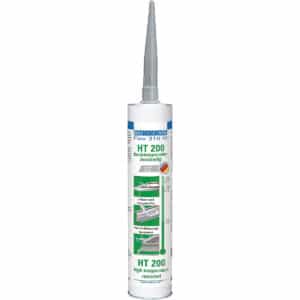
Weicon Flex 310 PU Polyurethane-Based Adhesive

It is a polyurethane-based, single-component industrial adhesive used to provide both bonding and sealing in assembly and maintenance applications. Because it remains elastic after curing, it helps tolerate movement caused by vibration and thermal expansion. With its paintable structure, it offers a practical solution for visible joints.
 Shipping Time 24 Hours : Weekdays 09:00-17:00
- 100% Original: All products with UTM Teknik guarantee


Weicon Flex 310 PU Polyurethane-Based Adhesive is a polyurethane-based, single-component industrial adhesive/sealant that cures with moisture. Thanks to its permanently elastic structure, it is intended to form a joint line that can tolerate movement in assemblies where both bonding and sealing are required. Its paintability helps maintain surface integrity, especially in visible joints. Its silicone-free character offers an alternative industrial adhesive solution for processes where silicone is not suitable.
Technical identity of Flex 310 PU as an industrial adhesive
This product is a 1K polyurethane (PUR)-based, paste-like industrial adhesive and is positioned as a “kleb- und dichtstoff,” meaning a system that targets both bonding and sealing. Since it is moisture-curing (feuchtigkeitshärtend), ambient conditions are the main variable affecting curing speed in typical applications. It is described for creating a bond and providing sealing on various substrates such as metals, many plastics, ceramics, wood, glass, and stone. Manufacturer/origin: WEICON GmbH & Co. KG, Münster, Germany.
Performance features and resistance approach
Despite its elastic structure, Flex 310 PU is designed with a focus on strong adhesion (haftstark) to support joint continuity against vibration, expansion/contraction, and surface movement in assemblies. Because elongation at break is given as 450% in the technical data, it exhibits behavior aimed at reducing cracking risk in joints that require elasticity. Tensile strength is specified as 2 MPa and average tensile shear strength as 1.6 MPa; these values may vary in practice depending on material combination and surface preparation. Since paintability is defined as “after full curing,” the painting process should be planned once curing is complete.
Gap filling and suitability for service conditions
This industrial adhesive aims to create a more reliable filled joint line in assemblies with surface tolerances, with a gap-bridging capacity of up to 5 mm. Because the maximum sealing joint width is given as 25 mm, it is important that joint design stays within this limit. Shore A hardness is specified as 45±5, indicating a sealant-like behavior that remains elastic while retaining shape. Temperature resistance is specified as -40 °C to +90 °C, and up to +120 °C for short periods (about 2 hours), enabling usage planning under varying service conditions.
Application method and process management
Cleaning and degreasing the surfaces before application helps make industrial adhesive performance more repeatable. The paste consistency is suitable for controlled application with a cartridge gun or pneumatic cartridge gun and can also be integrated into the process with automatic dosing systems. After application, parts must be joined before skin formation occurs for ideal wetting; otherwise, the initial film formed on the surface can negatively affect wetting and adhesion. Keeping the processing temperature between +5 °C and +40 °C aligns with the manufacturer’s approach for curing and workability.
Curing time and impact on work planning
Since the curing rate is given as 2–3 mm in the first 24 hours, final curing time should be planned longer for thick-section applications. The skin-over time is specified at around 45 minutes; setting up the assembly sequence within this time window can be critical, especially in serial production. Application conditions are stated as +5 to +35 °C and 40–70% relative humidity, making it easier to standardize results in facilities with controlled workshop climate. This approach supports process discipline to avoid voids in sealing lines and to achieve a uniform bond line.
Sector-specific applications and key advantages
Flex 310 PU is described for use in vessel and fixture manufacturing, bodywork/container/vehicle production, ventilation and air-conditioning (HVAC), plastics technologies, and the energy and electrical industries. In areas where silicone is not suitable, combining bonding and sealing in a single permanently elastic industrial adhesive can simplify processes. Emphasis on weathering and aging resistance and resistance to fresh/salt water supports its use in outdoor environments and humid operating conditions. Information such as ISEGA certification and the DIN 4102 B2 building material class provides a practical framework for documentation and compliance processes.
Additional information
| Renk | Black, Grey, White |
|---|
Related products