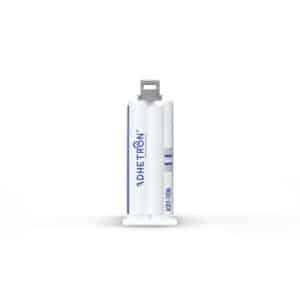
Adhetron PU-Tron 335-T10X Thermally Conductive Silicone-Free Adhesive 50 ml


It is a silicone-free industrial adhesive with thermally conductive properties. It is used in electronic components, heat spreaders, and metal-surface assembly applications, and stands out for its reliable adhesion, clean process compatibility, and structure that supports heat transfer.
 Shipping Time 24 Hours : Weekdays 09:00-17:00
- 100% Original: All products with UTM Teknik guarantee


Adhetron PU-Tron 335-T10X is an industrial adhesive positioned as a polyurethane-based, two-component thermal interface material focused on high thermal conductivity. Thanks to its silicone-free formulation, the product is especially suited to clean-process expectations in electronic assembly and applications requiring heat management. According to the official technical data, it provides a thermal conductivity of 3 W/mK and can achieve adhesion on different surfaces, especially aluminum. This makes the product not only a gap-filling material, but also a functional industrial adhesive that contributes to heat transfer.
Technical Structure and Key Properties of PU-TRON 335-T10X
The chemical basis of this product relies on polyurethane technology and is supported by special thermal fillers. In the technical datasheet, the product is described as off-white in color, paste in form, with a specific gravity of 3.4 g/cm³ and a volumetric mixing ratio of 100:100. Its open time is around 60 minutes; the application temperature is specified as 23–60°C, while manual cartridge application is stated to be more suitable in the 50–60°C range. These data show that the product has a technically predictable structure in assembly processes requiring controlled dispensing and heat transfer.
Thermal Performance and Strength Data
The product’s standout performance criterion is the thermal conductivity value of 3 W/mK stated in the official TDS. In the cured properties section, the flammability rating is given as 94 V-0, while the lap shear strength measured after 7 days is specified as ≥1 MPa on an isopropanol-cleaned aluminum surface with a 1 mm bond line thickness. According to the manufacturer’s information, Adhetron is a brand of Pulsar Chem. Industry and Trade Co. INC.; the brand structure originates from Connecticut, USA, and associates its R&D and manufacturing infrastructure with the USA, Great Britain, and Japan, while operating its distribution network through Türkiye. On the technical side, standard-related information is kept limited in the document, and the main verifiable data set is concentrated on thermal conductivity, flammability, and adhesion strength.
Application Method and Surface Compatibility
Because of its two-component structure, the product should be considered within a ratio-controlled application logic, and the official data clearly states a volumetric mixing ratio of 100:100. In cartridge-based application scenarios, the note that the material processes more efficiently in the 50–60°C range is important in terms of flow and dosing stability in field use. The manufacturer states that the parts can be assembled quickly with low pressing force and that good adhesion is achieved on aluminum and other surfaces; this highlights the product as a functional industrial adhesive in assemblies requiring heat transfer. In terms of storage, a shelf life of 6 months at room temperature in unopened original packaging is specified.
Applications and Industry Compatibility of PU-TRON 335-T10X
According to the manufacturer’s positioning of its conductive adhesive class, products of this type are used in systems that help dissipate heat in processors, power transistors, and similar heat-generating electronic components. The same manufacturer group associates this solution family with electronics, automotive electronics, telecom equipment, lighting, energy, and various industrial assembly fields. In this context, PU-TRON 335-T10X can be considered for use in power electronics modules, assemblies of metal-bodied electronic components, aluminum-based heat spreader bonding, and compact systems requiring controlled thermal management. Its silicone-free structure may be a reason for preference especially in processes where silicone contamination risk is undesirable. Its application focus is not conventional general-purpose bonding, but rather technical assembly scenarios in which heat transfer and mechanical joining are expected together.
Related products