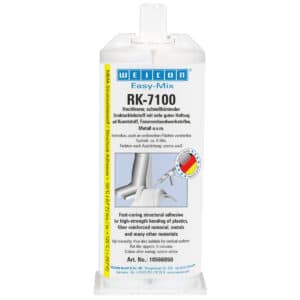
WEICON Plastic-Bond Structural Adhesive 24 ml


This product is a two-component, MMA-based industrial adhesive developed for structural bonding of materials such as plastics and metal. It is used in machine manufacturing, automotive, and electrical applications for plastic part assembly, bracket connections, and maintenance/repair work. It allows controlled application, tolerates gaps to a certain extent, and forms a durable bond line.
 Shipping Time 24 Hours : Weekdays 09:00-17:00
- 100% Original: All products with UTM Teknik guarantee


Weicon Plastic-Bond Structural Adhesive 24 ml is a two-component, MMA (methyl methacrylate)-based, solvent-free industrial adhesive system designed to achieve high-strength bonding across different types of plastics. Thanks to its viscous structure, it reduces the tendency to run on vertical surfaces and supports a more controlled bond line. It is positioned as a solution focused on impact and peel resistance in assemblies exposed to static and dynamic loads. The manufacturer is WEICON, and the company’s headquarters are stated to be in Germany.
What is the Plastic-Bond structural industrial adhesive used for?
This industrial adhesive is developed to create structural joints not only on plastics but also on aluminium, steel, and many other materials. In high-strength bonding, it can be preferred to reduce the need for mechanical fasteners or to offer an alternative joining method in certain applications. A maximum gap-bridging capability of 5 mm provides application flexibility in assemblies where surface tolerances are not perfectly ideal. Due to its low tendency to flow, it offers a usage profile that supports workmanship quality, especially on vertical surfaces and in on-site maintenance and repair work.
Technical structure, curing pace, and strength framework
The mixing ratio is given as 1:1 by weight, and the mixed viscosity is stated in the range of 40,000–60,000 mPa·s; these values are important for controlled dosing and managing squeeze-out. A working time of about 15 minutes at 20 °C requires that assembly preparation be completed before application. It reaches handling strength in about 40 minutes and a level suitable for service strength in about 60 minutes, and a curing window of about 12 hours is defined for final strength. Service temperature resistance is stated as -55 °C to +125 °C, providing a practical limit for many industrial assemblies exposed to variable ambient temperatures.
Substrate compatibility and example mechanical performance approach
Example tensile shear strength values provided according to DIN EN 1465 show the decisive impact of surface preparation on performance. Values are reported as 23 N/mm² on grit-blasted steel, 22 N/mm² on grit-blasted stainless steel, and 20 N/mm² on grit-blasted aluminium, while values on plastics can vary significantly depending on the material. For this reason, when selecting plastics, surface energy, roughness, and joint geometry should be evaluated together. An electrical parameter is also given as 21 kV/mm dielectric strength at 20 °C according to DIN EN 60243-1, which can help in specification matching for electrical and electronics applications.
Application method and process control points
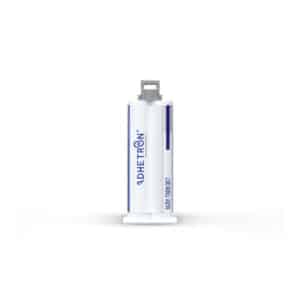
Application is carried out via a dual cartridge with a static mixer, and discarding the first approximately 5 cm bead is recommended to support mixing stability. The adhesive is typically applied to one surface, and the parts are quickly joined and fixed; since taking larger mixed quantities can accelerate curing, consumption and workflow planning should be arranged accordingly. For best results, keeping surfaces clean, dry, and free of oil is considered critical; mechanical roughening (sanding/grit blasting) strengthens adhesion in most scenarios. Since the processing temperature range is given as +10 °C to +40 °C and a minimum of +18 °C is specified for curing, workshop temperature and ambient control directly affect quality.
Industry applications and key advantages
Usage examples include plastics technology, metal construction, bodywork and vehicle manufacturing, machine manufacturing, electrical engineering, woodworking, and exhibition/stand installation. Its high viscosity providing more manageable application on vertical surfaces is a practical advantage for maintenance and repair teams. Thanks to its gap-bridging capability, it can compensate for surface tolerances to a certain extent and support assembly repeatability. The presence of the IMPA 812993 code on the procurement/specification side can also make matching easier in corporate purchasing processes.