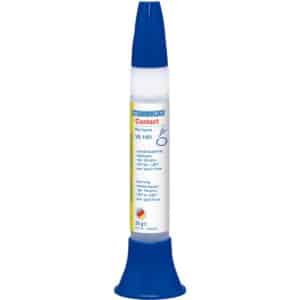
Adhetron Ca-Tron Black Rubber-Filled Cyanoacrylate Adhesive


It is a rubber-filled cyanoacrylate industrial adhesive. It is used for assembling dissimilar materials such as metal–plastic and metal–rubber, and for fixing gaskets and elastomer parts. With fast fixturing, it provides a tougher bond that is more resistant to impact and vibration.
 Shipping Time 24 Hours : Weekdays 09:00-17:00
- 100% Original: All products with UTM Teknik guarantee


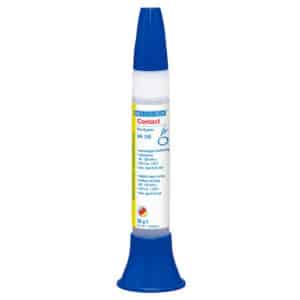
Adhetron Ca-Tron Black Rubber-Filled Cyanoacrylate Adhesive 50 g is a fast-curing industrial adhesive that, thanks to its rubber-toughened structure, aims to deliver more durable bonds against impact, vibration, and peel forces. Its black liquid form provides an advantage for controlled application, especially in assemblies involving flexible surfaces and the bonding of dissimilar materials. Chemically, it is ethyl cyanoacrylate–based, and the elastomer filler in the formulation is intended to create a tougher and more flexible bond line. The Adhetron brand is offered under Pulsar Chem Industry and Trade Co. Inc.
What is Ca-Tron Black industrial adhesive and what needs is it designed for?
This product is positioned as a rubber-reinforced industrial adhesive in the cyanoacrylate “instant-bonding” class. The elastomer filler approach targets a tougher bond line under impact and vibration compared to standard cyanoacrylates and supports performance against peel loads. Its black, medium-to-high viscosity liquid structure helps enable a more stable application in areas where run-off and spreading need to be controlled. Manufacturer documentation explicitly states that it is suitable for bonding flexible substrates and dissimilar materials (for example, metal–plastic or metal–rubber combinations).
Performance profile, durability approach, and core technical framework
This ethyl cyanoacrylate–based industrial adhesive is defined as a black liquid with a viscosity range of 3000–4000 mPa·s at 25°C; its specific gravity is given as 1.06 at 25°C. In the cured state, tensile strength is listed by elastomer type as 2–6 N/mm² on EPDM and 5–15 N/mm² on neoprene and nitrile rubber. Lap-shear (ISO 4587) values are shared as 15–25 N/mm² on steel, 7–10 N/mm² on aluminum, and 5–10 N/mm² on ABS and polycarbonate—indicating a versatile bonding profile across metal, plastic, and rubber combinations. The manufacturer presents the effects of temperature and environmental/chemical exposure in “strength retention” graphs, including data intended to track retention particularly in environments such as water and high humidity.
Application method and key points in the assembly process
For cyanoacrylate-based products, effective results generally require surfaces to be dry, clean, and free of oil; this supports fast fixturing while helping the bond line remain stable. Under conditions of 22°C and 50% relative humidity, the manufacturer provides the time to reach 0.1 N/mm² strength for different substrates in the order of seconds; values such as <20 seconds for EPDM and neoprene and <15 seconds for nitrile rubber illustrate this speed. Since similarly short fixturing windows are described for substrates such as ABS, polycarbonate, and steel, it is important to incorporate alignment and hold time into the process plan. Application is typically carried out by dispensing a thin film onto one surface, quickly joining the parts, and holding them in place until initial grab is achieved; the higher viscosity range also supports control.
Compatible substrates and sector-based use cases
This industrial adhesive is described as suitable for bonding different materials such as rubber, plastic, metal, and composites, with a particular focus on “flexible substrates” and “dissimilar materials” scenarios. Typical examples include fixing EPDM/nitrile gaskets to metal carriers or plastic housings in automotive and transportation, neoprene-to-metal joints, and assembly points exposed to vibration. In electrical/electronics and white goods, fast fixturing can support production speed in assemblies where ABS/polycarbonate housing parts are joined with metal components. In composite and industrial maintenance/repair applications, the goal of a tough bond line resistant to impact and peel stands out for small-part assemblies that combine dissimilar materials.
Storage, shelf life, and note on standards/certification
The recommended storage temperature is given as 4°C, and storage in a cool, dry place away from direct sunlight is advised; shelf life is stated as 12 months. Because of its fast-curing nature, not leaving the cap open and maintaining dispensing discipline to prevent nozzle tip clogging can help reduce waste. On Pulsar Kimya’s product page, gap-filling capability is summarized as 0.5 mm and fixture time as 10–30 seconds; these details clarify process expectations for assemblies with small tolerance gaps. Since no additional certification/standard claim is stated for this product in the manufacturer’s TDS content, for regulation-critical applications it is appropriate to proceed with internal validation tests along with the required safety documentation.
Additional information
| Miktar | 50 g, 500 g |
|---|