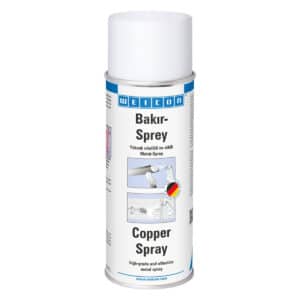
Weicon Copper Paste Assembly Spray, 400 ml


This technical spray is a copper paste–based assembly product that helps make assembly easier on screw connections and sliding surfaces. By forming a protective film against corrosion and rust seizing, it offers practical application and easier disassembly in maintenance and removal operations.
 Shipping Time 24 Hours : Weekdays 09:00-17:00
- 100% Original: All products with UTM Teknik guarantee


Weicon Copper Paste Assembly Spray 400 ml is a technical spray solution developed to make assembly easier on connections operating under high temperature and high loads and to reduce the risk of seizing during disassembly. It helps manage adhesion problems caused by corrosion and rust by forming a protective, separating, and lubricating film on the surface. Thanks to its aerosol form, it can be applied quickly and evenly over large areas and provides practicality in maintenance operations. The manufacturer is stated as WEICON GmbH & Co. KG (Germany).
Protection, separation, and lubrication during assembly with Copper Paste Spray
This technical spray is positioned for assembly lubrication of screw connections and all types of sliding surfaces. It forms a separating film layer that protects functional surfaces in insert-type power tools, wear bushings, bolts and fasteners, as well as press-fit and bayonet-type joints. The resulting film acts as a supportive barrier particularly against conditions that make disassembly difficult, such as “rust seizing” and fretting corrosion. The product is described with features such as high-temperature resistance, corrosion resistance, and strong adhesion, and it is stated to contain no sulfur, lead, or nickel.
Technical structure and durability approach of the copper paste technical spray
The copper paste assembly spray is defined as mineral oil-based and is given a consistency grade of NLGI 1. Being silicone-free may provide an advantage in terms of process compatibility in assembly and maintenance operations where silicone is not desired. An aluminum complex soap structure is mentioned as the thickener; this can be considered a supportive indicator for film stability and surface adhesion. Since the temperature resistance is given as -20 °C to +1,100 °C, it stands out for use scenarios on connections exposed to heat.
Practical notes on friction behavior and controlled tightening
Friction values are provided for different surface combinations, which can serve as a reference in applications aiming for more controlled tightening behavior in fasteners. In the four-ball VKA test, the weld load is stated as 3,200 N; this can be interpreted as a parameter supporting the durability approach of the film layer under high load. However, criteria such as assembly design, torque values, and fastener class are application-specific; therefore, it should not be treated as a single value that guarantees the same result in the field. This technical spray is positioned to help reduce seizing risk when used together with proper surface preparation and the correct application thickness.
Application method and storage of the copper paste assembly spray
Before application, it is recommended to clean the surface depending on contamination level and, if necessary, mechanically prepare used bolts with a wire brush; then remove oil/dirt residues with a suitable cleaner. The aerosol can is shaken and applied evenly from about 15 cm; in screw connections, reaching into the thread roots is considered important for a “better sealing effect.” It is stated that the product should not be mixed with other oils and greases to prevent changes in properties, and it is emphasized that this type of paste is not a direct one-to-one replacement for conventional oil/grease lubrication. Due to the pressurized can, it should be protected from direct sunlight and not exposed to temperatures above +50 °C.
Compatible use cases and sector examples
This technical spray is evaluated as assembly support at points where metal-to-metal contact is critical, such as screw connections, press-fit joints, and sliding surfaces. Examples of use include brake pads and guides, brake cams and pins for vibration reduction; it is also described as a practical assembly aid for battery terminals and other electrical connections in automotive and heavy-vehicle applications. It is positioned to support maintenance processes in connections that are difficult to loosen, such as wheel bolts/nuts, and in wear bushings of electric, pneumatic, or hydraulic breakers. In energy, maintenance and repair, heavy industry, and vehicle maintenance workshops, it offers a technical spray alternative used with a “protect-separate-lubricate” approach at connection points where heat and corrosion occur together.
Related products