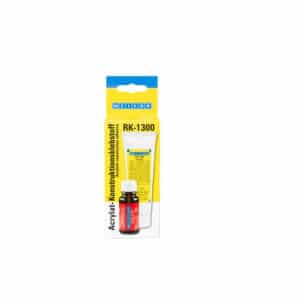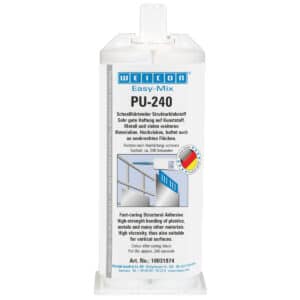
Adhetron Acry-Tron 1E1 High-Performance Acrylic-Based Adhesive 50 ml

 Shipping Time 24 Hours : Weekdays 09:00-17:00
- 100% Original: All products with UTM Teknik guarantee


Adhetron Acry-Tron 1E1 is a structural, acrylic-based industrial adhesive with 100% solids content, developed with a low-odor profile and a focus on high-temperature resistance. Its two-component system works at a 1:1 mix ratio and is designed to form a flexible bond line that helps accommodate differences in thermal expansion between dissimilar materials. It is suitable for assembly and production processes where reliable bonding is required in metal, plastic, and composite combinations. Manufacturer/origin in one sentence: Adhetron is a brand of Pulsar Kimya Sanayi ve Ticaret A.Ş. and is based in Türkiye.
Definition and Chemical Structure of the Acry-Tron 1E1 Structural Industrial Adhesive
This product is positioned as an acrylic “toughened” structural industrial adhesive, aiming for lower hazard and low odor through an MMA-free formulation approach. Its 100% solids structure focuses on reducing volume loss associated with solvent evaporation and contributes to process repeatability. Since it is a two-component product, correct mixing and proper surface preparation are key factors that determine bonding performance. Acry-Tron 1E1 is described as brownish-green in color, and the 50 ml cartridge format provides controlled dispensing and application convenience.
Technical Performance, Strength, and Process Parameters
For Acry-Tron 1E1, the mix ratio is specified as 1:1 and viscosity is stated at 10,000 cps; this helps limit run-off on vertical surfaces while supporting a fuller bond line. Working time is defined as 5 minutes, and fixture time is given in the 8–12 minute range; functional strength is achieved in approximately 2 hours. Full cure time is typically stated as 18 hours, and it should be considered that ambient temperature and surface conditions may affect the process. Service temperature resistance is given as -40 °C to +220 °C, which can be a technical advantage for teams selecting an industrial adhesive for applications exposed to thermal cycling.
Bond Strength and Flexibility Behavior
One of the critical indicators for structural adhesives is lap shear strength, and for this product values are reported as 28.9 MPa on steel/steel and 20 MPa on aluminum/aluminum. A result of 23.5 MPa on stainless steel/stainless steel indicates that a reliable bond line is targeted for metal construction assemblies. The toughened acrylic structure is intended to tolerate stresses arising from impact, vibration, and thermal expansion differences between dissimilar materials. With post-cure hardness specified as Shore D 55, the product can be considered an industrial adhesive designed to balance strength with a certain degree of flexibility.
Application Method, Compatible Substrates, and Storage
Before application, removing oil, dirt, oxides, and weak coating residues from surfaces is a critical step for bonding quality. The product can be applied using a static mixing tip or via the “bead on bead” method, which allows adaptation to different equipment and process scenarios in the field. Recommended substrates include steel, aluminum, copper, brass, stainless steel, coated metals, glass, wood, ABS, and rigid PVC; it also has use in composites such as concrete, stone, and FRP/GRP. A storage range of 12–23 °C is recommended, and the shelf life of components A & B is stated as a maximum of 9 months, making stock control and FIFO practices important.
Sector-Based Uses and Key Advantages
This acrylic-based industrial adhesive has a broad range of applications in production and maintenance lines where metal-to-metal, metal-to-plastic, and metal-to-composite joints are used. In automotive and the supply chain, it can be considered for brackets, body components, and assembly fixtures; in white goods and electrical equipment, for body-to-chassis connections. In lighting and metalworking applications, it may be preferred for assemblies where both thermal resistance and flexibility are required. Low odor and an MMA-free structure stand out as key advantages for user comfort and process safety in enclosed-area installations. Since the technical documents do not state a specific certification/standard claim, conformity for standards-driven projects should be clarified through internal testing and validation processes.