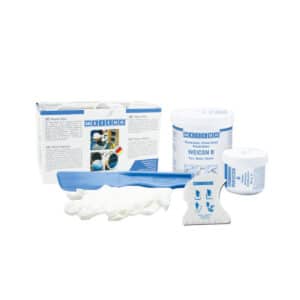
Weicon Ceramic W wear-resistant epoxy resin


It is a two-component epoxy resin–based wear-protection coating; with its paste-like, non-sagging consistency, it is used for surface repair and coating on vertical surfaces. It forms a hard layer on pump housings, pipes, slides, and metal surfaces exposed to heavy friction, helping to improve wear resistance.
 Shipping Time 24 Hours : Weekdays 09:00-17:00
- 100% Original: All products with UTM Teknik guarantee


Weicon Ceramic W wear-resistant epoxy resin is a two-component epoxy resin system used for coating and surface repair in areas exposed to intense friction and abrasion. Thanks to its paste-like, non-sagging consistency, it is designed to keep its shape on vertical surfaces and overhead applications. Its mineral-filled formulation is intended to improve wear protection, especially on heavily stressed equipment. The product is manufactured by Germany-based WEICON GmbH & Co. KG.
Technical structure and intended use of the Ceramic W epoxy resin
This system is epoxy-based and contains aluminum oxide as a filler. After curing, it forms a white, hard, and dense repair/coating layer, offering an advantage where dark-colored products are not preferred visually. As a chemical-resistant epoxy system, it can be considered for maintenance/repair and “surface armoring” applications. Its non-sagging consistency helps the material stay in place without flowing and allows shaping with a spatula.
Performance characteristics and resistance profile
Ceramic W is positioned for processes that require high temperature resistance in addition to wear protection. Temperature resistance is specified from -35 °C to +230 °C, and up to +250 °C for short-term exposure; this supports material selection for equipment operating under temperature fluctuations. The post-cure Shore D hardness is reported as 91±3, which supports form stability of the coating under mechanical load. The typical loss value stated for the Taber abrasion test reflects the product’s wear-resistance focus and targets predictable performance in heavy-duty scenarios.
Application method and curing process
The recommended processing temperature is +15 °C to +40 °C, with relative humidity below 85%. Since the mixing ratio is specified as 100:25 by weight, accurate proportioning and homogeneous mixing are basic requirements for performance. At 20 °C, the pot life for a 500 g mix is stated as 120 minutes, so the prepared quantity should be planned according to the workable time. The typical recoating time is 5 hours, the time to withstand mechanical load is 7 hours, and the time to reach final hardness is 24 hours; ambient temperature can affect these times in practice.
Surface preparation, compatible substrates, and critical application tips
For a successful result, the surface must be completely free of oil, grease, dirt, rust, oxides, and paint residues; surface preparation is the most critical step for these epoxy systems. On heavily contaminated or smooth surfaces, grinding or preferably grit blasting is recommended, and after blasting the goal is to reach a cleanliness level close to SA 2½. Working a thin first layer into the surface with a spatula using crosswise movements helps the epoxy penetrate cracks and surface irregularities. Thanks to its non-sagging character suitable for vertical and overhead work, application control is easier on challenging geometries such as pump housings and pipe interiors/exteriors.
Sector-specific applications and key advantages
This epoxy resin system is used in special applications such as bonding or priming aluminum oxide stones in mill construction, and for priming and coating pump housings exposed to heavy stress. It can also be preferred for wear protection on equipment with high friction, such as sliding bearings, slides, and pipes. Machine and plant engineering, fixture/equipment engineering, and general industrial maintenance operations are among the typical application areas. Its white coating character can provide a controllable application appearance on the surface, making maintenance inspection more practical.
Additional information
| Miktar | 2 kg, 200 g, 500 g |
|---|