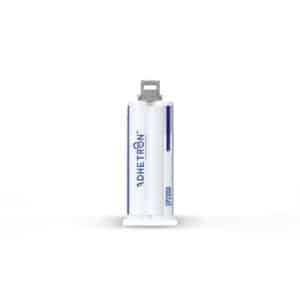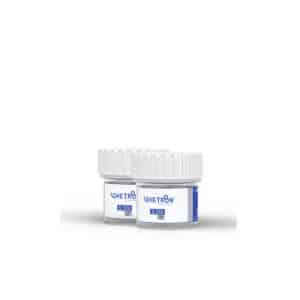
Adhetron EP2614 Electrical Insulating Two-Component Epoxy 275g


An electrically insulating, two-component epoxy industrial adhesive is used in electronic assemblies for underfill/filling, component fixing, and void filling applications. Its low viscosity allows it to flow into narrow gaps by capillary action, and its fast curing helps streamline production processes.
 Shipping Time 24 Hours : Weekdays 09:00-17:00
- 100% Original: All products with UTM Teknik guarantee


Adhetron EP2614 Electrical Insulating Two-Component Epoxy 275g is positioned as an epoxy-based industrial adhesive that can flow into gaps by capillary action thanks to its low-viscosity nature and cures quickly. It is intended for assembly and filling (underfill) applications requiring electrical insulation, especially for electronic components exposed to thermal cycling, where a reliable bond line is needed. Its compatibility with various substrates such as metal, plastics, ceramics, and ferrites enables flexible use in both production and maintenance processes. The Adhetron brand operates under Pulsar Kimya Sanayi ve Ticaret A.Ş., based in Türkiye.
EP2614 two-component epoxy industrial adhesive: product definition and chemical structure
This product is a two-part epoxy system consisting of a resin and a hardener, and after curing it forms a highly rigid polymer network. Its low-viscosity behavior provides an advantage in underfill-type applications because it helps the material flow into voids and progress through gaps. As an epoxy-based industrial adhesive, it focuses on maintaining bond-line stability in assemblies where electrical insulation is critical. Manufacturer technical documents state that the product is amber in color and that the mixture can be processed at low viscosity.
Technical performance and electrical insulation properties
For the cured material, the temperature resistance is specified as -40 °C to 260 °C, and it is stated to withstand multiple thermal cycles at 260 °C. On the mechanical side, Shore D hardness is specified as 80, while lap shear strength is listed as 2250 psi; these values correspond to a rigid, durable bond line requirement. For electrical insulation performance, the volume resistivity is given on the order of 10^15 Ω·cm, and dielectric strength is specified at approximately 17 kV/mm, which can be referenced for designs that require high insulation. In addition, parameters such as dielectric constant and dissipation factor are defined in the technical data sheet, supporting more controlled material selection for electronic applications.
Cure profile and process window
Typical curing times are given as 50–60 minutes at 100 °C, 30 minutes at 125 °C, 5 minutes at 150 °C, and less than 1 minute at 180 °C; this allows the process to be adjusted according to equipment heating capacity and part sensitivity. The combination of low viscosity and fast curing can provide a productivity advantage on lines targeting short cycle times. The glass transition temperature (Tg) is specified as 125 °C, offering a practical threshold for operating temperature and mechanical stability considerations. Because ionic contamination is important in electronics-grade applications, contents such as chlorine/sodium/potassium are listed at low levels in the technical data sheet, which is particularly relevant for sensitive circuit assemblies.
Mix ratio, pot life, and storage notes
The mix ratio of the two components is specified as 100:8 by weight, and controlling this ratio by weighing supports process repeatability. Since the pot life at 25 °C is specified as 3 days, the usable time after mixing can be managed clearly in production planning. Shelf life is specified as 12 months at room temperature in unopened original packaging, which can be used for inventory control. A note that the hardener (Part B) may crystallize during storage and that this can be reversed by heating at 60 °C for 1 hour provides a practical tip for addressing viscosity changes encountered in the field.
Application method and industry-specific use cases
In application, removing oil, dust, and dirt from surfaces is the first step that determines adhesion quality in epoxy-based industrial adhesive systems. Due to its low viscosity, the material can advance into tight gaps by capillary action, making it suitable for underfill and void-filling scenarios; dispensing is typically controlled using syringe/dispense equipment. In electronics manufacturing, it can be considered for sensor assembly, fixation of coil and ferrite parts, and maintaining bond-line stability under vibration and thermal cycling in power electronics components. In automotive electronics, defense/aerospace electronics, industrial control boards, and general electronics assembly lines, it can serve as an option for connections on metal, plastic, ceramic, and ferrite surfaces where electrical insulation is required.