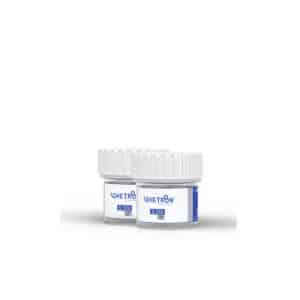
Weicon Ceramic BL high wear-resistant epoxy resin


It is a two-component epoxy resin–based wear-protection coating used for repairing and coating metal surfaces exposed to heavy friction and abrasive particle wear. It is brush-applied on equipment such as pump housings, pipes, hoppers, and valves, forming a hard and durable layer that helps extend service life.
 Shipping Time 24 Hours : Weekdays 09:00-17:00
- 100% Original: All products with UTM Teknik guarantee


Weicon Ceramic BL high wear-resistant epoxy resin is a two-component epoxy resin system designed for protective coating and surface repair on surfaces exposed to intense friction and abrasive particle wear. Thanks to its flowable consistency, it can be applied by brush and is intended to form an even coating film. Its formulation filled with silicon carbide and zirconium silicate is developed to enhance wear protection, especially under heavy-duty conditions. The product is manufactured by Germany-based WEICON GmbH & Co. KG.
Technical structure and working principle of the Ceramic BL epoxy resin
This epoxy resin system has a “mineral-filled, flowable” character and forms a blue coating layer after curing. The mixing ratio is specified as 100:8 by weight (100:15 by volume); the correct ratio is critical for a homogeneous mix and repeatable performance. At +25 °C, the mixture viscosity is stated as 23,000 mPa·s and the density as 1.9 g/cm³; these values indicate a consistency intended for brush-applied priming/coating. At a 1.0 mm layer thickness, typical consumption is 1.9 kg/m², and the recommended maximum layer thickness in one step is 10 mm.
Application method and curing management
The application temperature is defined as +15 °C to +40 °C, with relative humidity below 85%; additionally, the component temperature must be at least 3 °C above the dew point. Because the pot life at 20 °C (for 500 g of material) is stated as 55 minutes, the prepared mix should be planned in quantities that can be applied within this time window. The “next coat time” is specified as 5 hours, the time to withstand mechanical load as 8 hours, and the time to reach final hardness as 12 hours; in practice, process temperature can affect these times. Since shrinkage is given as 0.13%, this information can be considered when planning coating thickness and repair geometry.
Resistance profile and key performance properties
After curing, tensile strength is reported as 59 MPa, compressive strength as 116 MPa, and Shore D hardness as 90±3; this combination is intended to support form stability of the coating under mechanical load. Adhesion strength (pull-off) is given as 17 MPa, and lap shear strength on blast-cleaned steel is stated as 12 MPa; proper surface preparation is decisive for these results. In the Taber abrasion test (H18, 1 kg, 1000 cycles), a loss value of 0.3 g / 0.17 cm³ is reported, which is one of the key indicators supporting the product’s “high wear protection” purpose. Temperature resistance is stated as -35 °C to +180 °C, supporting coating selection for equipment operating at elevated temperatures.
Surface preparation, compatible substrates, and critical process tips
The most critical step for successful application is surface preparation; it is explicitly emphasized that dust, dirt, oil, grease, rust, oxides, and paint negatively affect adhesion. Especially on smooth or heavily contaminated surfaces, grinding or preferably grit blasting is recommended, and achieving a blasting cleanliness level of SA 2½ is required; the targeted surface profile is 75–100 µm. For metal parts exposed to seawater or salt solutions, rinsing with deionized water and performing soluble salt testing according to the Bresle method are recommended; the maximum allowable soluble salt level on the substrate is given as 40 mg/m². These practices help reduce the risk of early delamination and support longer service life.
Sector-specific applications, advantages, and standards information
Ceramic BL is positioned for priming of pump housings exposed to heavy wear, wear protection on sliding bearings, slides, hoppers, and pipes, as well as repair of cast parts, valves, and fan blades. Its flowable, brushable character supports fast on-site coating work by maintenance teams. The product supports selection criteria in regulation-sensitive applications through references such as compliance with DNV rules, suitability for drinking water according to BS 6920, and guideline references such as ISEGA/LFGB/EC 1935/2004. Compatibility within the system together with GL, and the fact that different colors can help visual wear monitoring, are also stated as practical advantages.
Additional information
| Miktar | 2 kg, 200 g, 500 g |
|---|
Related products