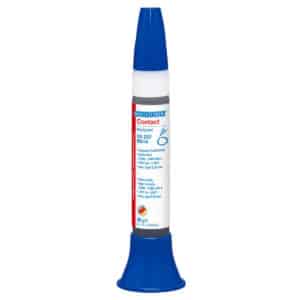
Weicon Contact VA 8406 Cyanoacrylate Adhesive


It is a cyanoacrylate-based industrial adhesive used for fast fixing of rubber and plastic parts. In high-volume assembly and maintenance applications, it provides very fast bonding on small components, helping to shorten process time.
 Shipping Time 24 Hours : Weekdays 09:00-17:00
- 100% Original: All products with UTM Teknik guarantee


Weicon Contact VA 8406 Cyanoacrylate Adhesive is a low-viscosity, very fast-curing industrial adhesive developed for the quick fixing of rubber and plastics. Thanks to moisture-triggered cyanoacrylate chemistry, it achieves initial bonding in a short time and supports process speed in high-volume assembly and maintenance work. Its colorless, transparent nature makes it suitable for applications where a cleaner finish is desired at visible bonding points. As a single-component product, it offers practical on-site use and aims for reliable results with proper surface preparation.
VA 8406 industrial adhesive structure and basic operating principle
This product is a single-component, ethyl-based cyanoacrylate industrial adhesive and is applied in liquid form. Its low viscosity range (20–50 mPa·s) penetrates narrow gaps more easily, providing fast wetting especially on rubber and plastic surfaces. A maximum gap-filling capacity of up to 0.1 mm helps create a controlled bond line on well-fitting surfaces. Solid rubber, porous rubber, plastics, and EPDM elastomers are the main material group; additionally, with a suitable primer, it can also be used on difficult substrates such as PE, PP, PTFE, and silicone. Being silicone-free can be an advantage in production processes where silicone contamination is undesirable.
Performance characteristics, strength approach, and temperature resistance
VA 8406 is positioned as a “very fast hardening” product that can provide initial bonding within seconds, while a 24-hour curing time is taken as the basis for full final strength development. As an industrial adhesive, its performance may vary depending on factors such as substrate type, surface energy, and ambient humidity, so running process trials is appropriate for critical applications. Temperature resistance is given as -50 °C to +80 °C, with short-term resistance up to +100 °C, helping define boundary conditions for joints exposed to heat. Shear strength values are reported separately for different substrates, making correct material pairing important in application design. Within this framework, it offers a stable bonding solution for small parts and fine details that require fast fixturing.
Application method and process window
Before application, surfaces must be clean and dry; dust, dirt, and moisture can significantly reduce adhesion. The adhesive is generally applied to only one of the bonding surfaces, and parts are quickly joined and fixed because curing begins with ambient moisture. The recommended processing temperature is +15 °C to +40 °C, and a relative humidity range of 40%–70% is specified; under very low humidity, curing can slow down noticeably. Keeping the bond-line thickness roughly within 0.05–0.2 mm is important for complete curing and stable results. For larger surfaces, spot/drop application is highlighted to help reduce internal stresses.
Compatible surfaces, application areas, and compliance information
This industrial adhesive can be preferred in automotive suppliers and general assembly lines for plastic clips, elastomer parts, EPDM details, and small components requiring rapid fixing. In electrical and electronics assembly, it provides a practical solution for fast fixturing of plastic housing parts, cable-duct accessories, and small components. In machinery maintenance, it can offer a process advantage for teams targeting short downtime when repairing rubber-plastic auxiliary parts. For difficult-to-bond materials (such as PE, PP, PTFE, and silicone), the option of surface pre-treatment with a primer broadens the application scope. On the compliance side, references are stated to ISEGA as well as EC 1935/2004 and LFGB §§ 30–31; for storage, a minimum shelf life of 9 months at room temperature and 12 months at +2 °C to +7 °C is given.
Additional information
| Miktar | 30 g, 500 g, 60 g |
|---|
Related products