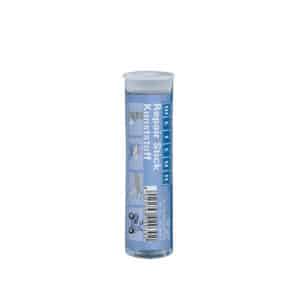
Weicon HP High-Strength Epoxy Resin


It is a mineral-filled, two-component, epoxy-based industrial adhesive and repair/coating paste. It is used for gap filling, surface restoration, and protective coating on equipment exposed to heavy impact and wear. Its paste consistency provides control on vertical surfaces, and its adhesion approach to damp surfaces adds practicality in the field.
 Shipping Time 24 Hours : Weekdays 09:00-17:00
- 100% Original: All products with UTM Teknik guarantee


Weicon HP High-Strength Epoxy Resin is a two-component epoxy resin system with mineral fillers and a paste-like consistency. It offers an industrial adhesive approach that can be used both for repair and for coating/priming in areas exposed to heavy impact and wear. Its high residual elasticity aim is designed to help manage cracking risk in equipment subjected to vibration. The product is manufactured by WEICON GmbH & Co. KG and originates from Germany.
Product definition and chemical structure of the WEICON HP epoxy system
The HP system is based on a combination of an epoxy resin and mineral filler, making void filling and shaping more controlled. Its paste structure reduces sagging on vertical surfaces, facilitates in-place repair applications, and forms a stable line on the surface as an industrial adhesive. The product’s white formulation makes it easier to visually track the application area. Its adhesion approach to damp and wet surfaces can be an advantage in maintenance environments where a “fully dry surface” is not always available. This structure focuses on multiple functions with a single product, particularly for wear protection and internal equipment surface coating.
Performance characteristics and strength framework of HP epoxy
In terms of post-cure mechanical performance, tensile strength is defined as 31 MPa and compressive strength as 65 MPa, supporting the formation of a load-bearing repair line together with the filler. The emphasis on impact strength and abrasion resistance can be decisive for industrial adhesive selection in high-friction areas such as plain-bearing zones, chutes, and pipe interiors. Since the hardness value is given as Shore D 75±3, the aim is for the surface to become both durable and workable after application. Temperature resistance is stated as -35 °C to +160 °C, offering a predictable operating band for general industrial equipment housings and process connections. Adhesion values defined for surfaces such as grit-blasted steel and stainless steel indicate that strong adhesion can be achieved with proper surface preparation.
Mixing, application method, and process window
For successful application, the surface must be fully cleaned of oil, dirt, rust/oxides, and loose layers; where possible, roughening by sanding or grit blasting is recommended. Since the mixing ratio is given as 100:83 by weight, measurement discipline plays a critical role in consistent industrial adhesive performance. With a pot life of 30 minutes at 20 °C for a 500 g batch, the amount prepared should be planned so it can be applied within this time. The maximum layer thickness in a single step is defined as 10 mm; for deeper voids, a staged filling approach delivers more controlled results. Reaching working strength in around 12 hours and final strength in around 36 hours helps clarify commissioning timing in maintenance planning. The application temperature should be kept between +15 °C and +40 °C, and in high-humidity conditions the surface preparation and curing window should be managed more carefully.
Sector-specific applications and compatible surfaces
This epoxy system stands out in maintenance and repair tasks such as repairs around cracks and reinforcement of impact zones in vibrating machinery. In wear-focused applications such as priming/coating pump housings, chutes, pipe interiors, and equipment exposed to heavy loads, it offers an industrial adhesive solution that combines filling and bonding. With proper preparation, strong adhesion is targeted especially on metal surfaces such as grit-blasted steel, stainless steel, and aluminum. The approach for use on damp/wet surfaces and underwater can add practicality where fast field intervention is needed. In industrial facilities, maintenance teams may want to standardize filling, coating, and localized repairs with a single product to shorten downtime. For visible or critical parts, testing on a small area before full-scale use is a good practice to confirm surface compatibility and performance expectations.
Additional information
| Miktar | 2 kg, 200 g, 500 g |
|---|