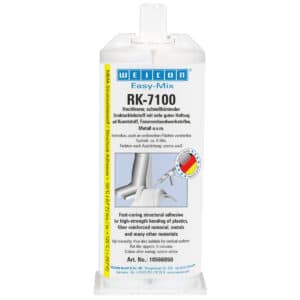
WEICON RK-1500 Structural Acrylic Adhesive 60 g (Transparent)

It is a structural acrylic industrial adhesive used with an activator and based on a No-Mix system that requires no mixing. It offers fast application and strong adhesion for assembling surfaces such as glass, metal, and ceramics. Transparent curing supports a cleaner finish in visible joints.
 Shipping Time 24 Hours : Weekdays 09:00-17:00
- 100% Original: All products with UTM Teknik guarantee


Weicon RK-1500 Structural Acrylic Adhesive 60 g (Transparent) is a structural industrial adhesive used together with an activator and based on a “No-Mix” principle that does not require manual mixing. Its low-viscosity consistency helps it spread evenly over large bonding areas, simplifying assembly processes. Its transparent/semi-transparent appearance is an advantage where aesthetics matter. It is manufactured by WEICON GmbH & Co. KG (Germany).
RK-1500 industrial adhesive: chemical structure and product positioning
This industrial adhesive is a methyl methacrylate-based structural acrylic system that works as a two-component concept together with an activator. The No-Mix approach helps reduce mixing-related errors and supports process standardization. Low viscosity enables controllable application, especially on large surfaces and in thin bond lines. The product’s slightly yellowish transparent character stands out in applications aiming to maintain visual integrity on surfaces such as glass and ceramics. In this respect, RK-1500 is considered a practical industrial adhesive alternative for serial assembly and maintenance/repair work.
Mechanical performance, temperature resistance, and gap-bridging capacity
RK-1500 structural acrylic industrial adhesive is positioned for applications that require high resistance to impact, peel, and shear loads. After curing, lap shear strength can reach levels such as 25 N/mm² on steel, 30 N/mm² on stainless steel, and 20 N/mm² on aluminum, depending on the substrate and surface preparation. The application range is given as +10 °C to +40 °C, and suitable ambient conditions are considered critical for repeatable results. Temperature resistance is -50 °C to +130 °C, with short-term resistance up to +180 °C. The system provides structural support in joints with certain tolerances thanks to a gap-bridging capability of up to approximately 0.4 mm.
No-Mix activator application method
In this industrial adhesive system, the process proceeds by applying the activator to one surface and then applying the adhesive to the opposite surface. Depending on the bond line and surface characteristics, the activator can be applied to one side or both sides; larger gaps and passive surfaces may typically require a two-sided approach. At room temperature, the activator is allowed to flash off on the surface for a defined time, specified as at least 5 minutes. The adhesive is generally applied to the surface without activator, parts are joined, and fixturing is completed quickly. Strength development is rapid: it reaches handling level in about 5 minutes, working strength in about 8 minutes, and typically achieves final strength within 24 hours.
Tips for surface preparation and process stability
Keeping surfaces clean, dry, and free of oil is the most fundamental step determining bonding performance. For higher strength, the contact area can be improved via mechanical abrasion methods such as sanding or blasting. On some plastics—especially materials such as polyamides, PTFE, and polyolefins—special surface pretreatments may be required; surface activation methods like plasma, corona, or flame can be helpful in such cases. Thin and controlled application reduces the risk of overflow and supports a smoother bond line formation. This approach contributes to reducing quality deviations in serial production.
Application areas and compatible substrates
RK-1500 industrial adhesive stands out as a strong option especially for bonding glass, metal, and ceramics both to themselves and to each other. Thanks to its fluid nature, it offers ease of application on large bonding areas, providing an advantage in assembling large parts. It can be used in areas such as machine and fixture manufacturing, metal construction, commercial vehicle and transport production, tool-and-die applications, and the building and furniture industries. Its transparent character supports assemblies where a cleaner appearance is desired in visible joints. The No-Mix process approach makes industrial adhesive use more manageable in fast production flows and in field maintenance scenarios that require practical application.